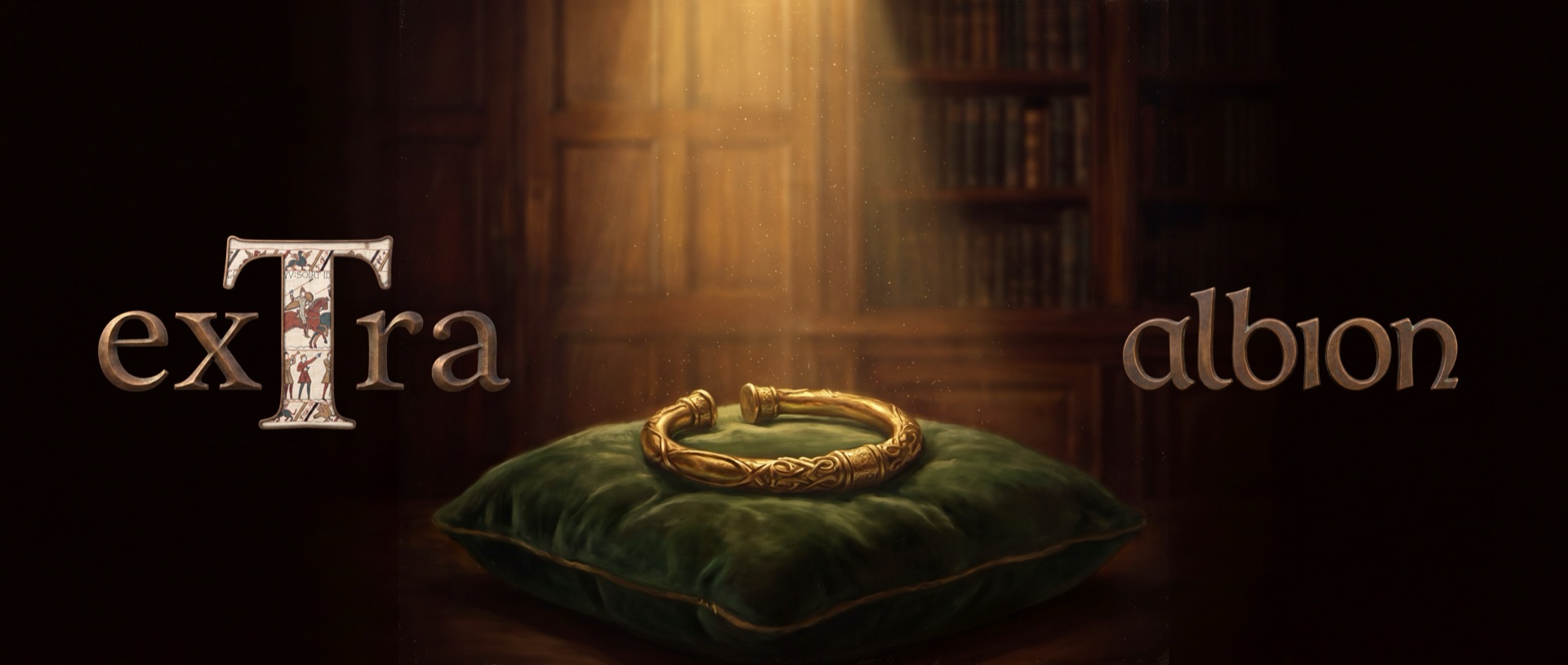
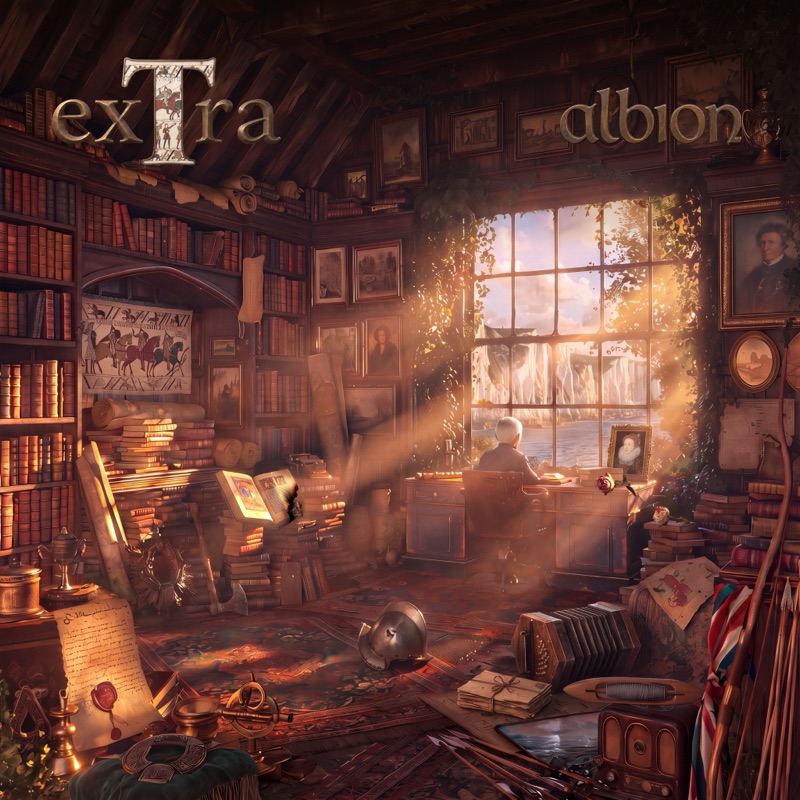
Albion is the oldest name for the island of Britain. It is older than Britannia, older than England, older than any flag ever raised over that coastline. exTra's third concept album walks that island from the Roman conquest to the present day and lets the people who lived there speak: a queen, a monk, a chronicler, a baron, an archer, a lady-in-waiting, a weaver, a soldier who would rather be home. Not one of them tells the whole truth.
Fifteen songs and two bonus tracks, from Celtic folk rock and English singer-songwriter ballads to a wartime film score and 1940s big band swing. It is also the first exTra album on which Tom Heinz plays on the recordings himself.
Albion is the oldest known name of Britain. It appears in Greek and Latin writings of antiquity, perhaps going back to sea routes described as early as the 6th century BC. Around 325 BC Pytheas of Massalia is said to have sailed around the island, the first traveller from the Mediterranean known to have described it. Pliny the Elder later noted that the island had once been called Albion. The name is usually traced to a Celtic root meaning white and is often linked to the chalk cliffs that greet anyone crossing from the continent. The overture stands for this first light: the moment the island steps out of prehistory into the written record.
Britain has been an island for around 8,000 years, since the sea rose after the last Ice Age and flooded Doggerland, the land bridge to the continent. Since then, nearly every chapter of its history has begun at the coast: the Romans in 43 AD, Angles, Saxons and Jutes from the 5th century, Viking raiders from 793, the Normans in 1066. Each of them left their mark in place names, in the law and in the English language itself. The island speaks here as the one constant beneath all of it, and its verses run ahead through the stations of the album, from Boudicca to the beheaded king and the mills of the industrial age.
Around 60 AD Prasutagus, king of the Iceni in what is now Norfolk, died. He had ruled as an ally of Rome and named Emperor Nero co-heir alongside his two daughters, hoping to protect his family. Rome annexed the kingdom anyway. According to Tacitus, Boudicca was flogged and her daughters were raped. While the governor Suetonius Paulinus was campaigning on Anglesey, she led the Iceni and the Trinovantes against Camulodunum (Colchester), Londinium and Verulamium (St Albans). The Roman writers put the dead at 70,000 to 80,000. On a battlefield that has never been located, the legions crushed the uprising. Boudicca died soon after, by poison according to Tacitus, of illness according to Cassius Dio. Everything we know about her was written by her enemies.
On 8 June 793 Norse raiders attacked the monastery of Lindisfarne off the coast of Northumbria, one of the holiest places in England. The Anglo-Saxon Chronicle records omens beforehand: whirlwinds, lightning and fiery dragons in the sky. Alcuin of York, then at the court of Charlemagne, wrote that never before had such terror appeared in Britain. It was not the first raid, but it shook Christian Europe. In 865 the Great Heathen Army landed in East Anglia, took York on 1 November 866 and stayed. Only Wessex under Alfred held out. After his victory at Edington in 878 the Danish leader Guthrum was baptised, and the north and east of England came under Danish law, the Danelaw. The lyrics quote the Chronicle and Alcuin's letters directly.
When Edward the Confessor died childless in January 1066, Harold Godwinson was crowned the next day. William, Duke of Normandy, claimed that Edward had promised him the throne and that Harold had sworn on holy relics to support him. Harold defeated the Norwegian king Harald Hardrada at Stamford Bridge, marched south and fell at Hastings on 14 October 1066. William was crowned at Christmas. When the north rose against him, he had the land between York and Durham laid waste in the winter of 1069/70. The chronicler Orderic Vitalis later put the dead at more than 100,000, probably an exaggeration. Our main source, William of Poitiers, was the Conqueror's own chaplain, and his Gesta Guillelmi is open propaganda. In the 17th century English radicals coined the phrase Norman Yoke for the idea that the conquest had robbed the English of their ancient freedoms.
King John lost Normandy to France in 1204 and spent the next ten years squeezing money out of his barons to win it back, among other things through scutage, a tax paid instead of military service. After his defeat at Bouvines in 1214 the barons rebelled and took London in May 1215. On 15 June 1215, at Runnymede on the Thames, John put his seal to a charter of 63 clauses. Clause 39 promised that no free man would be imprisoned or stripped of his rights except by the lawful judgement of his peers or by the law of the land. Ten weeks later Pope Innocent III declared the charter void, and civil war followed. When John died in October 1216, the regents of his nine-year-old son Henry III reissued it, and from then on it stayed. The barons fought for their own privileges. The idea that even a king is bound by the law outlived them.
In August 1415 Henry V landed in Normandy to press his claim to the French crown, a new chapter in the Hundred Years' War. The siege of Harfleur and dysentery cost him a large part of his army. On the march to English-held Calais, a French army blocked his way near Agincourt. On 25 October 1415, St Crispin's Day, the English stood on a narrow, freshly ploughed field soaked by rain, with sharpened stakes in front of the archers. The French men-at-arms struggled through the mud under the arrows and were cut down in the crush. When a new attack threatened, Henry had many of the prisoners killed. The chronicles speak of a vast French superiority. From the muster rolls the historian Anne Curry estimates at least 8,700 English against at most 12,000 French. Shakespeare turned the battle into a national myth in Henry V (1599). The title recalls Edward the Black Prince, who had won at Crécy (1346) and Poitiers (1356) with the same kind of longbowmen two generations earlier.
The Tudor rose joined the red rose of Lancaster and the white rose of York after the Wars of the Roses. Henry VIII, king from 1509, needed a male heir. When the Pope refused to annul his marriage to Catherine of Aragon, he broke with Rome: the Act of Supremacy of 1534 made him head of the Church of England. Thomas More and Bishop John Fisher were executed in 1535 for refusing to accept it, and the monasteries were dissolved. Of his six wives, two marriages were annulled, two wives were beheaded (Anne Boleyn in 1536, Catherine Howard in 1542), one died after giving birth and one outlived him. His daughter Elizabeth I, whom he had declared illegitimate, reigned from 1558 to 1603, more than 44 years, and never married. Her reign saw the defeat of the Spanish Armada in 1588. With her death the Tudor dynasty ended, and the crown passed to James VI of Scotland.
No king and no battle: this interlude belongs to the landscape. Yet even the patchwork of hedged fields that looks timelessly English is history. Between about 1750 and 1850 Parliament passed thousands of Enclosure Acts that turned open fields and common land into private, fenced and hedged plots. Farming became more productive, and many rural families lost their land and moved to the growing industrial towns where the later songs of the album take place. Grey sky and green hedgerows stand at the centre of the album, in the middle of a history that changed the face of the island too.
In August 1642 Charles I raised his standard at Nottingham. The conflict with Parliament over taxes, religion and the power of the crown had turned into war. Parliament created the New Model Army, in which promotion depended more on ability than on birth, and on 14 June 1645 it destroyed the royal army at Naseby. In January 1649 a special court tried the king for treason against his own people. On 30 January he stepped through a window of the Banqueting House in Whitehall onto the scaffold. According to tradition he wore two shirts so that the cold would not make him shiver as if in fear. England became a republic. In 1653 Oliver Cromwell dispersed Parliament and ruled as Lord Protector, and in 1660 the monarchy returned. The title comes from a ballad of 1646 protesting against Parliament's ban on Christmas and later became a byword for the radical ideas of the time.
Rule, Britannia! was written in 1740: Britannia, rule the waves, a demand rather than a fact. Within a century it had become one. The Seven Years' War from 1756 to 1763 brought Britain Canada and supremacy in India, Trafalgar in 1805 secured command of the seas, and naval bases from Bombay to the Cape held a global network together. HMS Victory, Nelson's flagship with more than a hundred guns, still lies at Portsmouth. The same seas carried the slave trade: between 1660 and 1807 British ships took around 3.1 million Africans across the Atlantic. Parliament banned the trade in 1807 and slavery itself in most of the empire in 1833, with compensation paid to the owners, not to the enslaved. The officer in the song has seen the chains and does not care.
In 1785 Edmund Cartwright patented the power loom. As the machines improved over the following decades, the steam-driven mills of Lancashire and Yorkshire pushed the wages of hand weavers down to poverty level. From 1811 to 1816 workers in the Midlands and the north smashed machines at night in the name of a fictional General Ludd. In 1812 Parliament made machine breaking a capital crime and sent thousands of soldiers into the region. Women were part of the unrest: in June 1812 Hannah Smith, aged 54, was hanged at Lancaster for her part in a food riot, probably the only woman executed for rioting in the 19th century. A few years earlier William Blake had written of dark Satanic Mills. Out of the machine breaking grew the trade unions and the Chartist movement of the 1830s and 1840s.
On 1 July 1916 the British army attacked on the Somme in Picardy. A week-long bombardment had come first, and contemporaries reported hearing it in southern England. On the first day alone the British lost more than 57,000 men killed, wounded or missing, over 19,000 of them dead, the worst day in the history of the British army. The battle lasted until November and gained about ten kilometres. Many of the soldiers were volunteers who had enlisted together with friends from the same town. A month earlier the Royal Navy had fought the German fleet at Jutland. Afterwards the German High Seas Fleet rarely put to sea again, while the British Grand Fleet kept up the blockade from Scapa Flow. The Thiepval Memorial on the Somme bears the names of more than 72,000 men with no known grave. The soldier in the song comes from Kent, the Garden of England, with its orchards and hop gardens.
In spring 1940 Germany overran the Netherlands, Belgium and France within six weeks. Between 26 May and 4 June more than 338,000 Allied soldiers were evacuated from Dunkirk, many of them by civilian boats. On 18 June, the day after France asked for an armistice, Churchill told the House of Commons that if the British Empire lasted for a thousand years, men would still say: This was their finest hour. From July the Luftwaffe fought for control of the air over southern England, the Battle of Britain. From 7 September London was bombed on 57 consecutive nights, and families slept in the Underground stations. By May 1941 the Blitz had killed more than 40,000 civilians. The spoken passages are not Churchill's words. They speak of what the great speeches left out.
On 23 June 2016, 51.9 percent of voters decided that the United Kingdom should leave the European Union. It left on 31 January 2020. Two years before the referendum, Scotland had voted on independence and stayed, with 55 percent against leaving. The arguments about who belongs and what the country should be are older than they seem. The island was shaped by those who arrived: Romans, Angles and Saxons, Danes, Normans, later Huguenots fleeing France, and from 1948 the Windrush generation from the Caribbean. And the British have fought bitterly among themselves before, to the point of beheading a king. The song places today's quarrel in this long line.
The afterlife of Magna Carta. After 1215 it was reissued in 1216, 1217 and 1225 and confirmed again and again by later kings, and in 1297 Edward I entered it into the statute book. In the 17th century the jurist Edward Coke used it against the Stuart kings. The American colonists later invoked it against London, and its ideas found their way into the US Bill of Rights. Four copies of the 1215 charter survive. In England three of its clauses are still in force today, among them the promise of lawful judgement. In 1957 the American Bar Association erected a memorial at Runnymede.
The Battle of Britain from both sides of the sky. The pilots of Fighter Command, many of them barely twenty, often went into combat with very little flying experience. On 20 August 1940 Churchill called them The Few: never in the field of human conflict was so much owed by so many to so few. Airfields in Kent such as Biggin Hill were bombed again and again in August and September. On the ground life went on: dance halls stayed open, women built aircraft and munitions, and when the sirens sounded, thousands went down into the Tube. Fighter Command lost 544 aircrew killed between July and October 1940.