The Songs
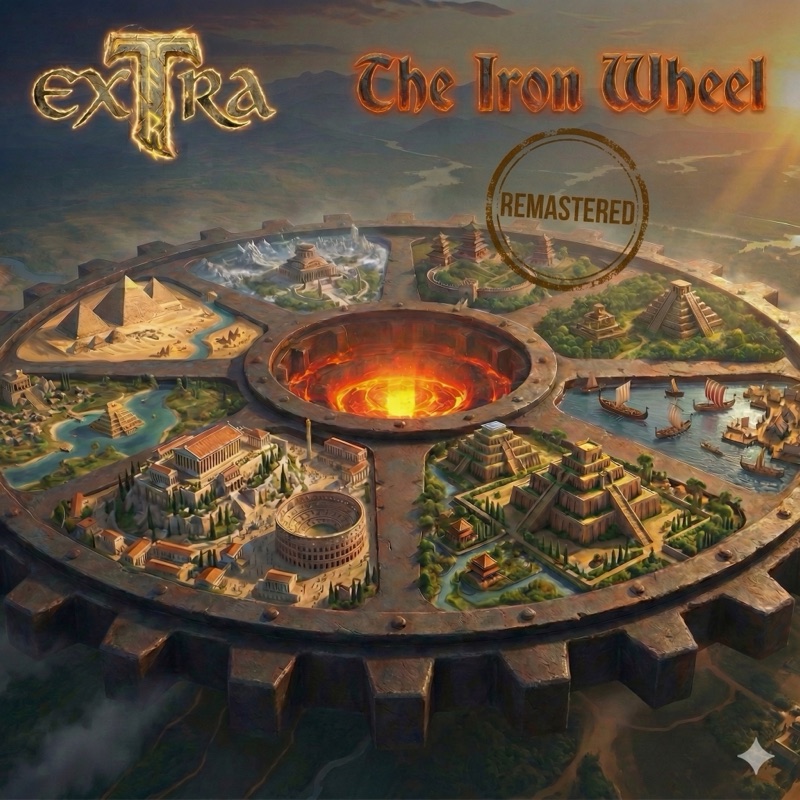
A concept album about the cycle of human civilizations. The listener is guided through the eyes of different cultures. The "Iron Wheel" is the common thread — it crushes the old to make way for the new.
Track 1 · Prologue
The Iron Wheel Part 1
The idea that history moves in circles is ancient. In the 2nd century BC the Greek historian Polybius described how forms of government inevitably follow and decay into one another. In the Middle Ages the wheel of fortune, the rota fortunae, raised kings up and threw them down again. In 1377 the Arab scholar Ibn Khaldun described the rise and fall of dynasties as a recurring cycle, and in the 20th century Oswald Spengler and Arnold Toynbee wrote of civilisations that grow, flourish and decline. The narrator of the prologue stands outside time and watches the wheel begin to turn.
Track 2 · Sumer
The First Turn (Cradle of Clay)
In southern Mesopotamia, between the Euphrates and the Tigris, the first cities arose in the 4th millennium BC. Around 3000 BC Uruk had tens of thousands of inhabitants, and around 3300 BC the oldest known writing appeared there: cuneiform on clay tablets, first used for bookkeeping. Mud bricks, irrigation canals and temples laid the foundations of city life. The oldest surviving law code was issued by Ur-Nammu of Ur around 2100 BC, and the stone stele of Hammurabi of Babylon followed some 350 years later. The Sumerian city-states were conquered again and again, and in the early 2nd millennium BC Sumerian died out as a spoken language. It lived on for centuries as a language of scholars.
Track 3 · Egypt
Sands of the Afterlife (The Serpent's Kiss)
No civilisation invested more in eternity than ancient Egypt. Around 2560 BC Pharaoh Khufu had the Great Pyramid of Giza built, for more than 3,800 years the tallest structure made by human hands. From the New Kingdom, about 1550 BC, the dead were given the Book of the Dead, a collection of spells for the journey through the underworld. In the hall of judgement the heart of the deceased was weighed against the feather of Maat, the goddess of truth and order. A heart too heavy was devoured. Pharaonic Egypt lasted some three thousand years. It ended in 30 BC with Cleopatra VII, who according to ancient tradition took her own life with the bite of a snake. Egypt became a Roman province.
Track 4 · Rome
The Eagle and the Wolf (Pax Romana)
According to legend, Rome was founded in 753 BC by Romulus, who with his twin Remus had been suckled by a she-wolf. The eagle, the aquila, was carried before every legion. After a century of civil wars Augustus became the first emperor in 27 BC. The roughly two hundred years that followed, until the death of Marcus Aurelius in 180 AD, are called the Pax Romana. At its greatest extent under Trajan in 117 AD the empire reached from Britain to Mesopotamia, held together by roads, aqueducts, Roman law and Latin. The peace was an inner one. On the frontiers the legions fought almost constantly, and the provinces paid with taxes and slaves. Tacitus has a Caledonian chieftain say of the Romans: They make a desert and call it peace.
Track 5 · The Fall · Instrumental
The Long Night (Echoes of the Fall)
In 476 the Germanic commander Odoacer deposed Romulus Augustulus, the last emperor in the West. The fall had been gradual: civil wars, economic crises, epidemics and migrating peoples had weakened the empire for generations, and Rome itself had been sacked in 410 and 455. In the West cities shrank, trade routes broke down, and skills such as building in stone on a large scale and widespread literacy declined. Petrarch later spoke of darkness, and the term Dark Ages stuck. Historians today avoid it: in the East the Roman Empire lived on in Byzantium for almost a thousand years, and the Islamic world preserved and developed ancient knowledge. The instrumental is a lament for what was lost between the empires.
Track 6 · The Mongols
Empire of the Blue Sky (The Endless Ride)
In 1206 an assembly of the Mongol tribes proclaimed Temüjin as Genghis Khan. Within a few decades his horsemen built the largest contiguous land empire in history, reaching at its height from Korea to Eastern Europe and from Siberia to the Persian Gulf. The conquests were extremely brutal: cities that resisted, such as Merv or Baghdad in 1258, were destroyed. At the same time the Mongols kept the Silk Road safe for trade, ran a relay postal system across Asia and tolerated many religions. Marco Polo travelled under this Pax Mongolica. The Mongols worshipped the Eternal Blue Sky, Tengri, which gives the song its title. By the late 14th century the empire had broken apart into rival khanates.
Track 7 · The Inca
Silence on the Andes
The Inca state Tawantinsuyu, the land of the four quarters, grew in about a century from a small kingdom around Cusco into the largest empire of the pre-Columbian Americas. From about 1438 Pachacuti began the great expansion. Around 1450 Machu Picchu was built, probably as his estate. Without the wheel for transport and without a script as we know it, the Inca ruled an estimated ten million people, using a road network of some 40,000 kilometres and knotted cords, the quipu, for record-keeping. At the centre of their religion stood the sun god Inti. Even before the Spanish arrived, a European epidemic, probably smallpox, killed the ruler Huayna Capac, and a civil war between his sons followed. In November 1532 Francisco Pizarro captured Atahualpa at Cajamarca with fewer than 200 men, and in 1533 he had him executed. The Spanish never found Machu Picchu.
Track 8 · The Ottomans
The Golden Horn (The Eternal State)
On 29 May 1453 Constantinople fell to the 21-year-old Ottoman sultan Mehmed II. For more than 1,100 years the city had been the capital of the Roman Empire in the East. The Byzantines had closed the Golden Horn, the city's harbour inlet, with a chain. Mehmed had dozens of ships hauled overland behind Galata and launched into the Horn. After the conquest he called himself Caesar of Rome. Istanbul became the capital of an empire that at its height under Suleiman the Magnificent in the 16th century reached from Hungary to Arabia and North Africa. The Ottomans called it the Eternal State, Devlet-i Ebed-müddet. It lasted more than six centuries, until the sultanate was abolished in 1922.
Track 9 · Spain
The Sun Never Sets (Plus Ultra)
In 1492, the year Granada fell and Columbus reached the Caribbean, Spain began its rise to world power. The young Charles V took Plus Ultra, further beyond, as his motto, turning around the ancient warning Non plus ultra, nothing beyond, said to have stood on the Pillars of Hercules at Gibraltar. Hernán Cortés conquered the Aztec Empire, Francisco Pizarro the Inca Empire, and silver from Potosí and Mexico flowed to Seville. Under Philip II, who also became king of Portugal in 1580, Spain ruled an empire on which the sun never set. But the silver drove up prices and paid for endless wars, Philip's treasury went bankrupt four times, and in 1588 the Armada sent against England failed. The 17th century brought a slow decline. Plus Ultra is still part of the Spanish coat of arms.
Track 10 · Britain
Albion (The Engine of the World)
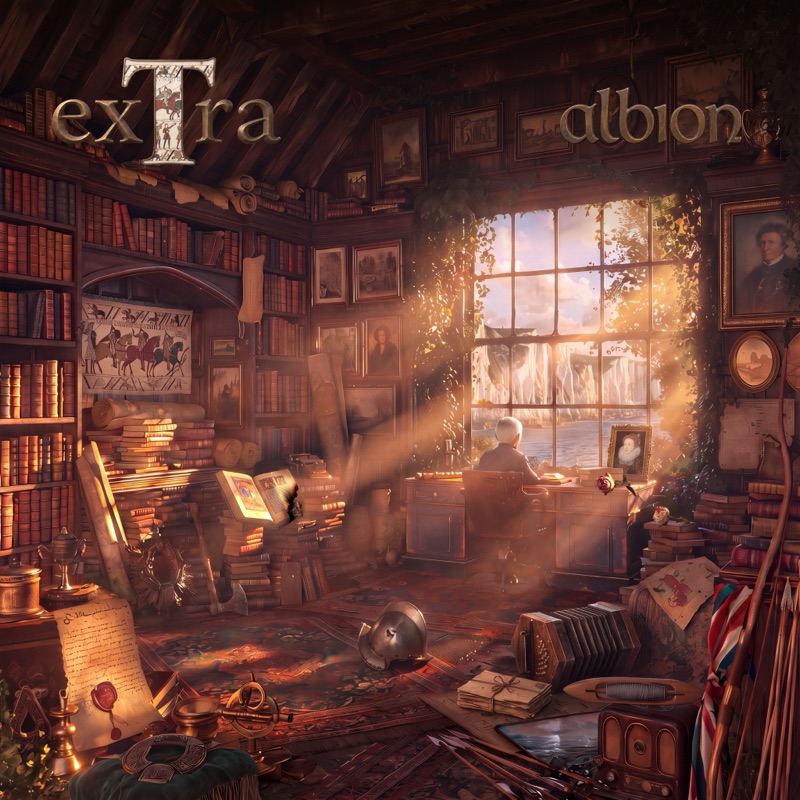
In 1769 James Watt patented his improved steam engine, and over the following decades Britain became the first industrial nation. Coal, iron, cotton and later the railways transformed the country. In 1830 the first intercity railway opened between Liverpool and Manchester. At the Great Exhibition of 1851 in the Crystal Palace, Britain presented itself as the workshop of the world, and by 1920 the British Empire covered about a quarter of the earth's land. Others paid the price: children in mines and mills, until laws such as the Factory Act of 1833 slowly restricted child labour, cities plagued by cholera and smog, and colonies whose economies were bent to the needs of the mother country. The song follows the rhythm of the machine that came to set the rhythm of life.
Track 11 · Epilogue
The Iron Wheel Part 2
We are back here. The epilogue brings the wheel into our own time. In 1905 the philosopher George Santayana wrote that those who cannot remember the past are condemned to repeat it. Whether history really runs in cycles is disputed among historians. Spengler's prophecy of the decline of the West was widely read after the First World War, but most researchers today see patterns, not laws. After Sumer, Egypt, Rome, the Mongols, the Inca, the Ottomans, Spain and Britain, the album asks whether our own time is just another spoke in the wheel.