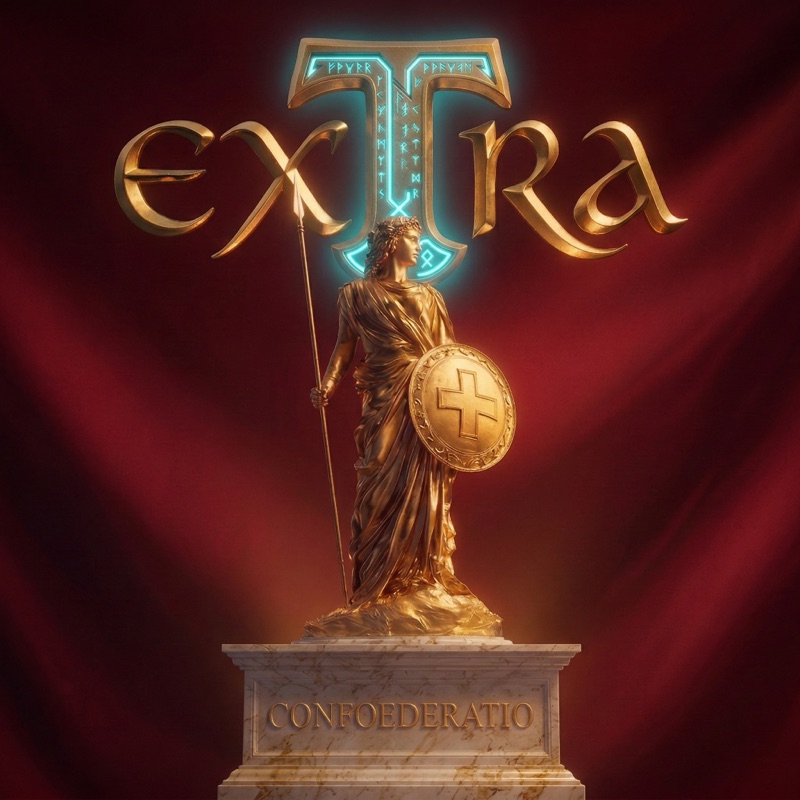
"Confoederatio" tells the story of Switzerland through the voices of those who shaped it. Each of the ten songs is narrated by a different historical figure, offering a deeply personal perspective on the events that shaped the nation. Musically, the album moves from Dark 70s Swiss Folk Rock through Liedermacher chanson, Gründerzeit shuffle, Glenn Miller Big Band swing, to ABBA-inspired disco.
"Confoederatio" tells the story of Switzerland through the voices of those who shaped it. Each of the ten songs is narrated by a historical figure — from the mythological mother of the nation to a modern Swiss citizen asking where the country goes next. The album spans over a thousand years of Swiss history, from Roman conquest to the age of artificial intelligence.
Helvetia, the female figure who personifies Switzerland, is younger than she looks. She appeared in the 17th century, when the Confederation needed a symbol for the whole beyond its individual cantons, and she has been on Swiss coins since 1850. Her name goes back to the Helvetii, a Celtic people who lived on the Swiss plateau in Roman times. Hence the country's Latin name Confoederatio Helvetica and the CH on every Swiss car. The landscape she speaks for was shaped by the glaciers of the Ice Ages, which carved out its valleys and lakes. In the song she looks back on all of it: the legions, the sons sent to foreign wars, the tunnels through the Alps.
In 58 BC the Helvetii left their homeland on the Swiss plateau, burned their towns and villages behind them and set out for the southwest of Gaul. Julius Caesar, governor of the Roman province, blocked their way at Geneva, pursued them and defeated them near Bibracte, the hill town of the Aedui in today's Burgundy. According to Caesar, 368,000 people set out and only 110,000 returned. Modern historians consider these figures exaggerated. Caesar sent the survivors back so that Germanic tribes would not move into the empty land. Almost everything we know about the campaign comes from Caesar's own account, De Bello Gallico, written to further his career in Rome. The song lets him tell it in his own voice.
Whether William Tell ever lived is not documented. The story first appears around 1470 in the White Book of Sarnen: the bailiff Gessler has a hat set up on a pole in Altdorf, Tell refuses to bow to it, is forced to shoot an apple off his son's head and later kills Gessler in the Hohle Gasse near Küssnacht. In the 16th century the chronicler Aegidius Tschudi dated the events to 1307. A very similar apple shot appears around 1200 in Saxo Grammaticus, told of a Danish archer named Toko. When a Bernese pastor called Tell a Danish fairy tale in 1760, a copy of his pamphlet was burned in Altdorf. Schiller's play of 1804 made Tell a hero of freedom across Europe. The song puts him on trial, with witnesses for and against.
For two centuries Swiss foot soldiers were among the most sought-after in Europe, and mercenary service was a major source of income for the Confederates. In 1515 they held the Duchy of Milan for its duke, Massimiliano Sforza. On 13 and 14 September 1515, at Marignano near Milan, they met the army of the young French king Francis I with its heavy artillery. After some twenty hours of fighting the Confederates withdrew, leaving around 10,000 dead. In 1516 they made a perpetual peace with France, followed by an alliance that allowed the French king to recruit Swiss mercenaries. Marignano marked the end of Swiss expansion. It is often called the birth of Swiss neutrality, but historians dispute that reading. Swiss mercenary service abroad continued into the 19th century.
Niklaus von Flüe, born in Obwalden in 1417, was a farmer, councillor, judge and soldier, and father of ten children. In 1467, at about fifty, he left his family with the consent of his wife Dorothee and lived as a hermit in the Ranft gorge. According to tradition he ate nothing for the rest of his life. After the Burgundian Wars the Confederation was deeply divided: the rural cantons opposed admitting the cities of Fribourg and Solothurn and quarrelled with the cities over the spoils of war. At the Diet of Stans in December 1481, when the talks were about to collapse, the parish priest Heimo Amgrund brought a message from Brother Klaus. Its wording is not known, but on 22 December agreement followed, the Covenant of Stans. The saying Don't build the fence too wide is attributed to him but not recorded in contemporary sources. He died in 1487 and was canonised in 1947. He is Switzerland's patron saint.
From 1519 Huldrych Zwingli preached the Reformation in Zurich. The Confederation split: Zurich, Bern and other cities on one side, the five Catholic cantons of central Switzerland on the other. In June 1529 the armies faced each other at Kappel am Albis, but there was no battle. According to tradition, soldiers from both sides shared a soup of milk and bread at the border, the Kappel milk soup. The First Peace of Kappel followed on 26 June 1529. Two years later, on 11 October 1531, war returned to the same place. Around 500 men from Zurich died, among them Zwingli, aged 47. His body was quartered and burned. The chronicler Heinrich Bullinger reports that Hans Schönbrunner from Zug wept over it. The Second Peace of Kappel in November 1531 stopped the spread of the Reformation in the Confederation for a long time.
On 13 June 1782 the maid Anna Göldi was beheaded in Glarus. Her employer, the physician and magistrate Johann Jakob Tschudi, accused her of having put pins into his daughter's bread and milk by sinister means. Under torture she confessed. The verdict called her a poisoner and avoided the word witch, but contemporaries saw it as a witch trial, and she is regarded as the last woman executed as a witch in Europe. The court clerk Johann Melchior Kubli passed the secret files to the German journalist Heinrich Ludwig Lehmann, and in 1783 the case became known across Europe. The word Justizmord, judicial murder, was first used in connection with it. It is suspected, but not proven, that Tschudi wanted to cover up an affair with her. In 2008 the Glarus parliament rehabilitated Anna Göldi.
Alfred Escher (1819 to 1882) was the most powerful man in 19th-century Switzerland. He led the Swiss Northeastern Railway, founded the Schweizerische Kreditanstalt in 1856, the bank later known as Credit Suisse, and played a key role in establishing the Federal Polytechnic School, today's ETH Zurich, in 1855. His greatest project was the Gotthard railway. But the tunnel cost far more than planned, and in 1878 Escher had to resign as president of the Gotthard Railway Company. He was not invited to the breakthrough in 1880 and stayed away from the opening in 1882 because of illness. He died in Zurich in December 1882. His opponents called him King Alfred, and the democratic movement of the 1860s turned against his system. Credit Suisse was taken over by UBS in 2023.
In summer 1940 Switzerland was surrounded by the Axis powers. On 25 July General Henri Guisan summoned the army's senior officers to the Rütli meadow and set out the Réduit: in case of attack the army would withdraw into the Alps and hold the Gotthard and the other passes, ready to destroy the transalpine routes. The cities of the plateau would be largely left to their fate. From November the Wahlen Plan, the so-called cultivation battle, turned parks and sports fields into potato and vegetable plots. At the same time Switzerland traded with Germany, the National Bank bought gold from the German Reichsbank, and goods kept rolling through the Gotthard. In 1938 Switzerland had pressed for the J stamp in the passports of German Jews, and in August 1942 it closed its borders to refugees fleeing for racial reasons. Federal Councillor Eduard von Steiger compared the country to a crowded lifeboat. The Bergier Commission counted around 24,500 refugees turned back at the border, a figure that is disputed.
The present. Zurich, where Alfred Escher once founded his bank, has become one of Europe's technology hubs, with one of Google's largest engineering sites outside the United States and with ETH, one of the world's leading universities. Credit Suisse collapsed in 2023 and was taken over by UBS. Since Russia's invasion of Ukraine in 2022, when Switzerland adopted the EU's sanctions, the meaning of neutrality has been debated as fiercely as rarely before, and so has the relationship with the European Union. The old question of how much of the world the country should let in keeps coming back to the ballot box. In its bridge the song looks back at all the figures of the album, from Helvetia to the woman of 1940.